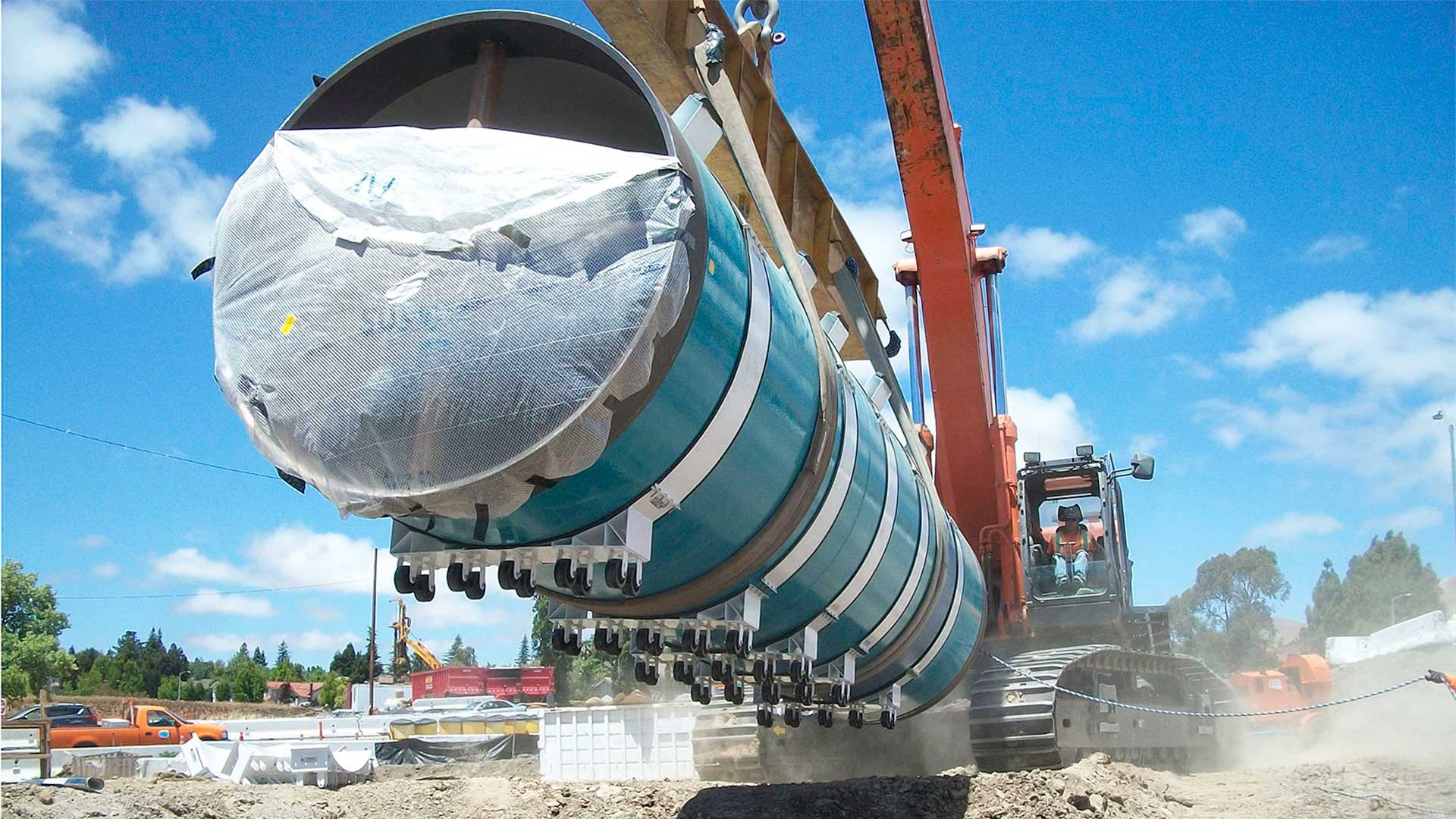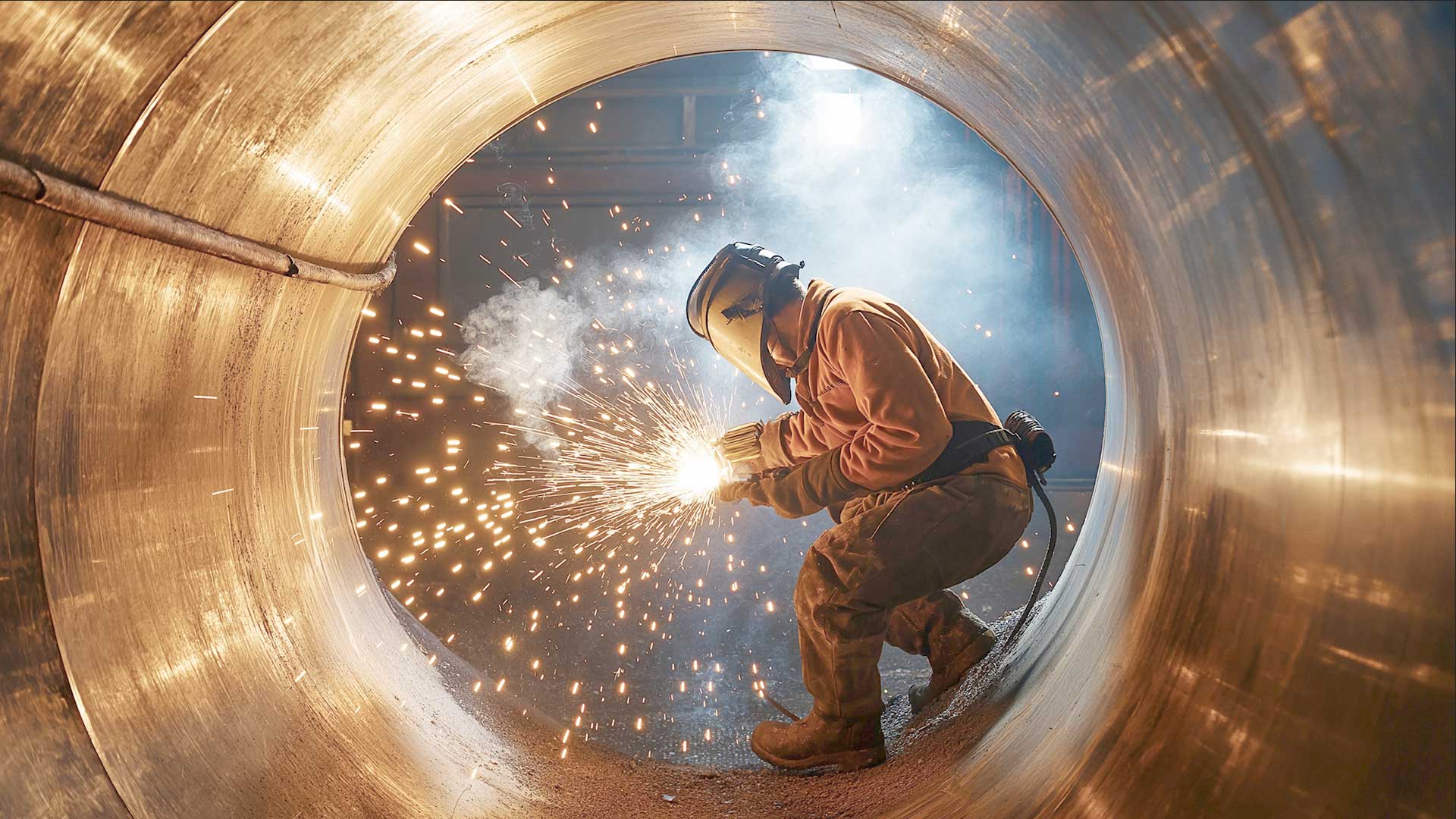
Steel water pipe plays a critical role in the infrastructure that delivers clean water and supports wastewater systems. Its design, fabrication, and installation require a thorough understanding of material properties, soil-structure interaction, and the engineering principles that ensure safety and long-term performance.
Hoop Stress and Design Considerations
One of the fundamental design checks for steel pipe is hoop stress, often calculated using the Barlow formula. This represents the internal pressure resisted by the pipe wall thickness.
- Steel Yield Strengths: Typical steels used in water and wastewater pipe have minimum specified yield strengths ranging from 36 ksi to 52 ksi, equating to design stresses of 18–26 ksi at working pressure.
- Coating Considerations: To protect certain coatings (e.g., cement mortar), design stress at all pressures is often limited to 18 ksi to prevent cracks from strain during operation.
Flexible Conduit Behavior
Unlike rigid materials, flexible conduits rely heavily on soil support. The pipe-soil system, rather than the steel pipe alone, determines load-bearing capacity.
- Soil’s Role: Proper side support from compacted soil allows the pipe to deflect outward under load, distributing pressure efficiently.
- Iowa Equation: The Modified Iowa equation is widely used to predict horizontal deflection, balancing pipe stiffness with soil stiffness.
- Allowable Deflection:
- 5% for flexible lining & coating (or unlined & uncoated)
- 3% for cement mortar lining with flexible coating
- 2% for cement mortar lining and coating
Notably, improving soil quality and compaction often increases allowable fill heights more effectively and economically than increasing wall thickness.
Steel Pipe Fittings
Steel pipe fittings provide the versatility needed for real-world installations where obstacles and design challenges arise.
- Common Fittings: Elbows, tees, crosses, reducers, laterals, and butt-strap closures.
- Customization: Special pipe and fittings can be fabricated to navigate obstacles, curves, or branches.
- Design Standards: Most fittings conform to AWWA C208, though modifications are made to ease installation and reduce the number of joints.
Elbows and Bends
- Standard radius: 2.5 times the pipe OD (results in minimal headloss).
- Minimum radius: About 0.6 times the pipe OD where space is limited. Note that decreasing the radius under 2.5*OD will frequently increase the wall thickness and cost.
- Mitered welds allow for custom deflections; a 4-miter 90° elbow is common.
- Stress increases in elbows are controlled by adhering to thickness and geometry guidelines.
Outlets and Reinforcement
Outlets in steel pipe systems may require reinforcement to handle internal pressures.
- Types of Reinforcement: Collars, wrappers, and crotch plates.
- Pressure-Diameter Value (PDV): Determines reinforcement type and size.
- ≤ 9000 PDV: Collars or wrappers
- > 9000 PDV: Crotch plates are required per AWWA M11
- Design Note: AWWA and ASME methods differ and should not be mixed within the same design process.
Joints and Couplings
The integrity and adaptability of a pipeline depend on its joints:
- Lap Welded Joints: Single welded lap joints offer strength in areas with longitudinal forces.
- Gasketed Joints: Economical, watertight, and easy to install. Best for non-restrained areas.
- Couplings and Anchor Rings: Used to address settlement, allow future pipe removal, or restrain thrust forces.
Key Takeaways
- Soil-structure interaction is as important as pipe strength in flexible designs.
- Coating systems dictate design stress limitations and allowable deflections.
- Customized fittings and reinforcements allow pipelines to adapt to real-world obstacles.
- Joint design balances economy, strength, and adaptability in installation and maintenance.
Conclusion
Steel water pipe remains a versatile, durable, and engineer-friendly material for water infrastructure projects. By applying sound engineering principles, respecting soil-structure interactions, and adhering to AWWA standards, designers can ensure long-lasting performance that meets both operational and environmental demands.