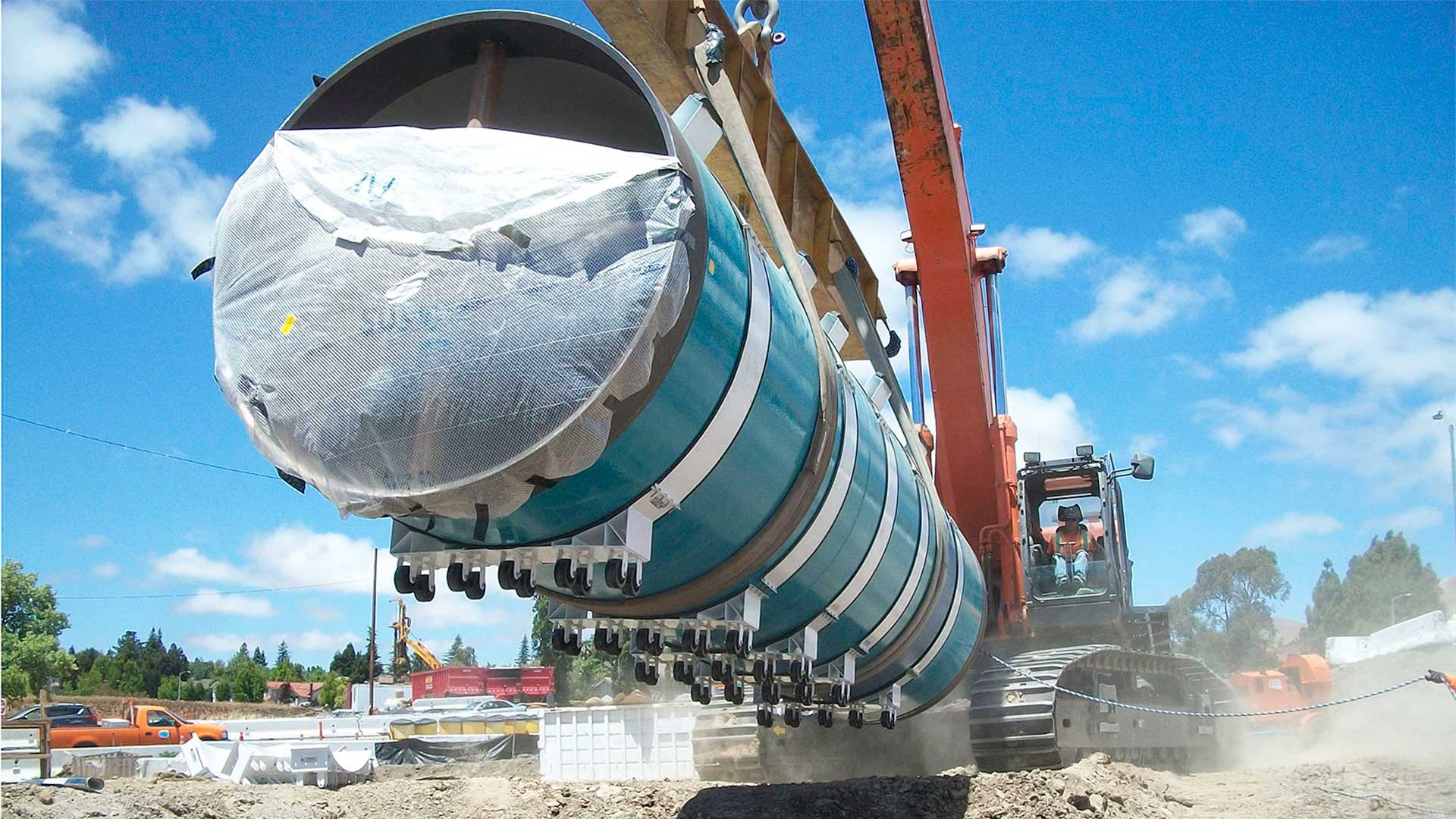

The final process is coating and you need coating to protect the steel. The coating operation can be broken down into three parts.
The first part is the cleaning and blasting. The pipe will be heated in order to clean the steel OD. Then it will be blasted to produce a near white blast.
Think of it as sanding a piece of wood before you paint. The substrate needs to be prepared in order to accept the coating.
Before we transfer the pipe to the masking station, we’ll validate that the surface prep required has been met.
Before we go into the second step of the coating process, we have to mask it. Each end of the pipe will be capped, and also setting the hold back areas for the coating.
The intent of the hold back area is to be sure that the pipe coating doesn’t interfere with a lap welded joint. Additionally, you want the pipe coating to be held back from any field welding zone.
The second step of the process is the application of the polyurethane coating on the steel pipe. When the pipe enters the spray booth, polyurethane is sprayed to provide a uniform coating to the specified thickness.
For a throughput operation, polyurethane is formulated to be snap set. This will allow the pipe to be handled immediately after the coating is applied.
To ensure we have a quality coating, 100% of the coating is holiday tested. Here, we are trying to pass a current through the coating from the pipe. If the metallic brushes detect a current, the system will jeep, and that area is repaired. Additionally, measurements are taken to confirm the coating thickness.
Now that the coating is complete, the pipe is transferred to the yard to install stulls and end caps.