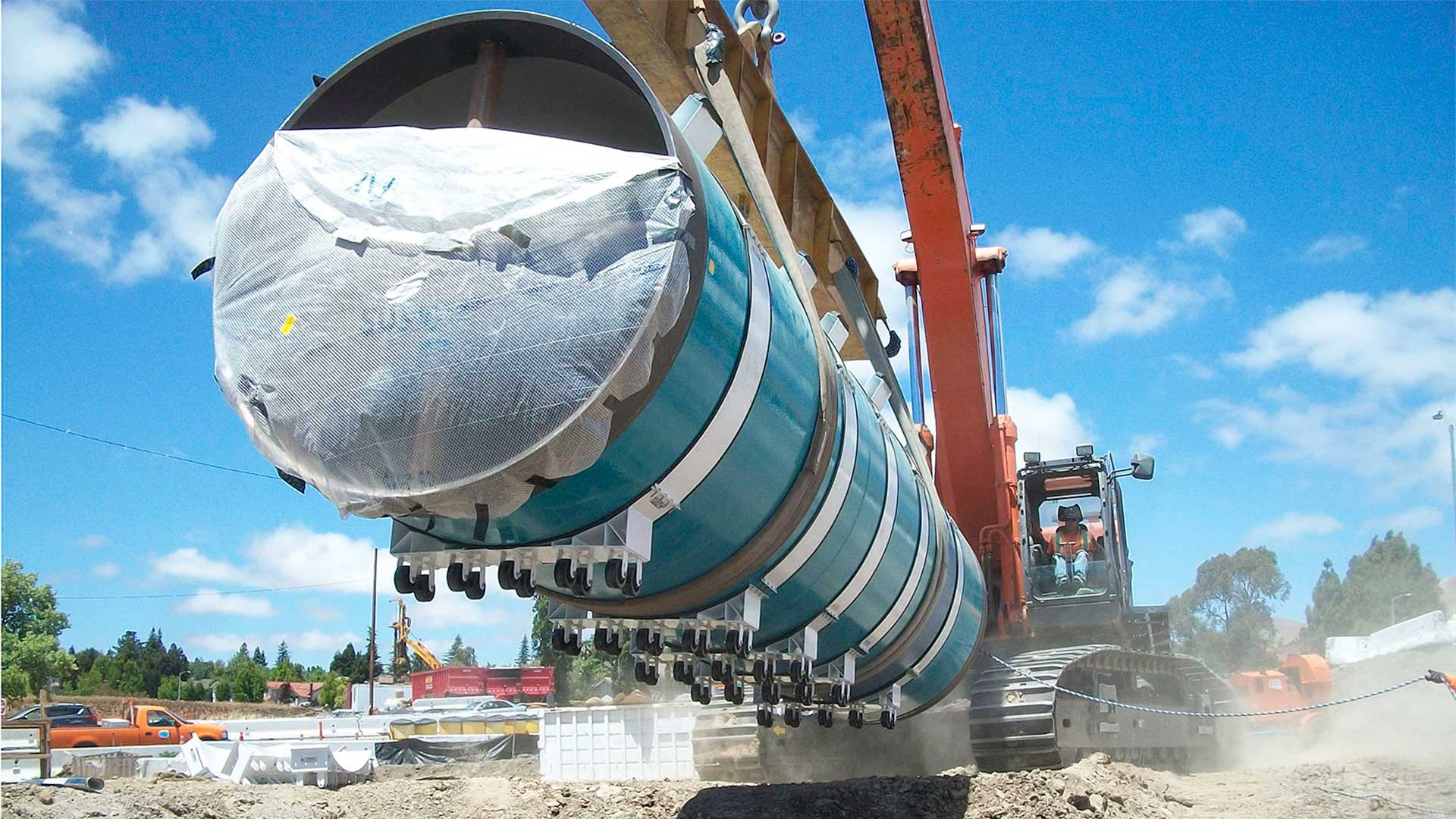

Now that the pipe is hydrostatically tested, we’re going to go through a series of steps in order to apply the cement mortar lining.
End dams are installed in each end of the pipe to ensure a uniform thickness of the applied cement mortar lining. It also helps maintain the cement inside the pipe during the application process.
The roundup rings are installed to help keep the pipe round during the application process, which will yield a uniform lining thickness. Additionally, the roundup rings will help keep the pipe stable during the spinning process.
Next up is the cement. The cement is mixed to a 2 to 1 sand to mortar ratio. It’s mixed on a batch basis, meaning there’s enough cement mixed for one pipe.
That mortar mixture is going to be loaded into a hopper and then staged, ready to be deposited into the pipe.
Now we’re going to load the pipe into the cement lining machine. The pipe is lowered onto the belts. Once the pipe is on the belts, a blower is going to be placed so it can blow any excess debris inside the pipe.
Once the blower cycle is complete, the lance that’s attached to the cart with the cement, is going to be inserted all the way into the pipe.
Once the lance reaches the far end of the pipe, the pipe is spinning and the lance will be retracted while the cement mortar is being deposited.
Now the pipe speed will be increased to induce a force on that lining equal to about 70 Gs. We’re trying to densify the lining and bring the water into the ID of the lining.
Now our blower will be installed again and blow the excess water through the pipe. Then the RPMs will stay at that high rate for several minutes until the lining is completely set.
Once the lining is completely set, the pipe is then removed from the machine. It’s important to note at this point we’re not going to be rolling the pipe anymore because we have the cement lining installed and it’s still in an unsecured state. You’ll see that the cart is going to retract the pipe without rolling it.
Now that the lining is complete, the next step is to remove the roundup rings and then transfer the pipe to the curing station.
Once the pipe is transferred to the curing bay, end caps are going to be placed on each end. When the end caps are in place, a steam line is going to be inserted into one end of the pipe in order to produce an environment inside the pipe, at least 90°F.
The steam curing process is complete after 18 hours, which is when the cement will reach its compressive strength required for the project specifications.
The end caps are removed, the steam lines are removed, and then the pipe is going to be transferred to the final stage, which is coating.