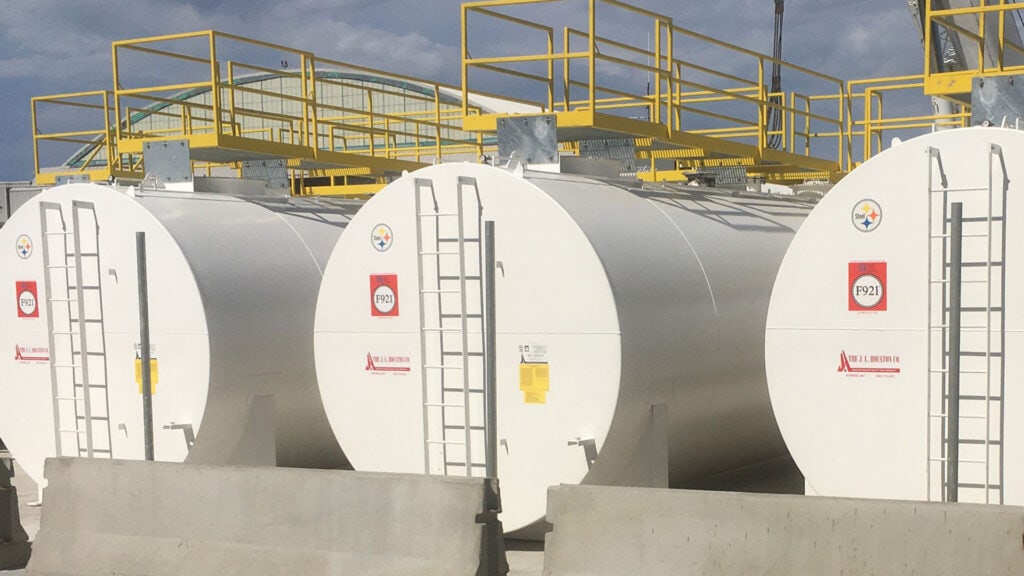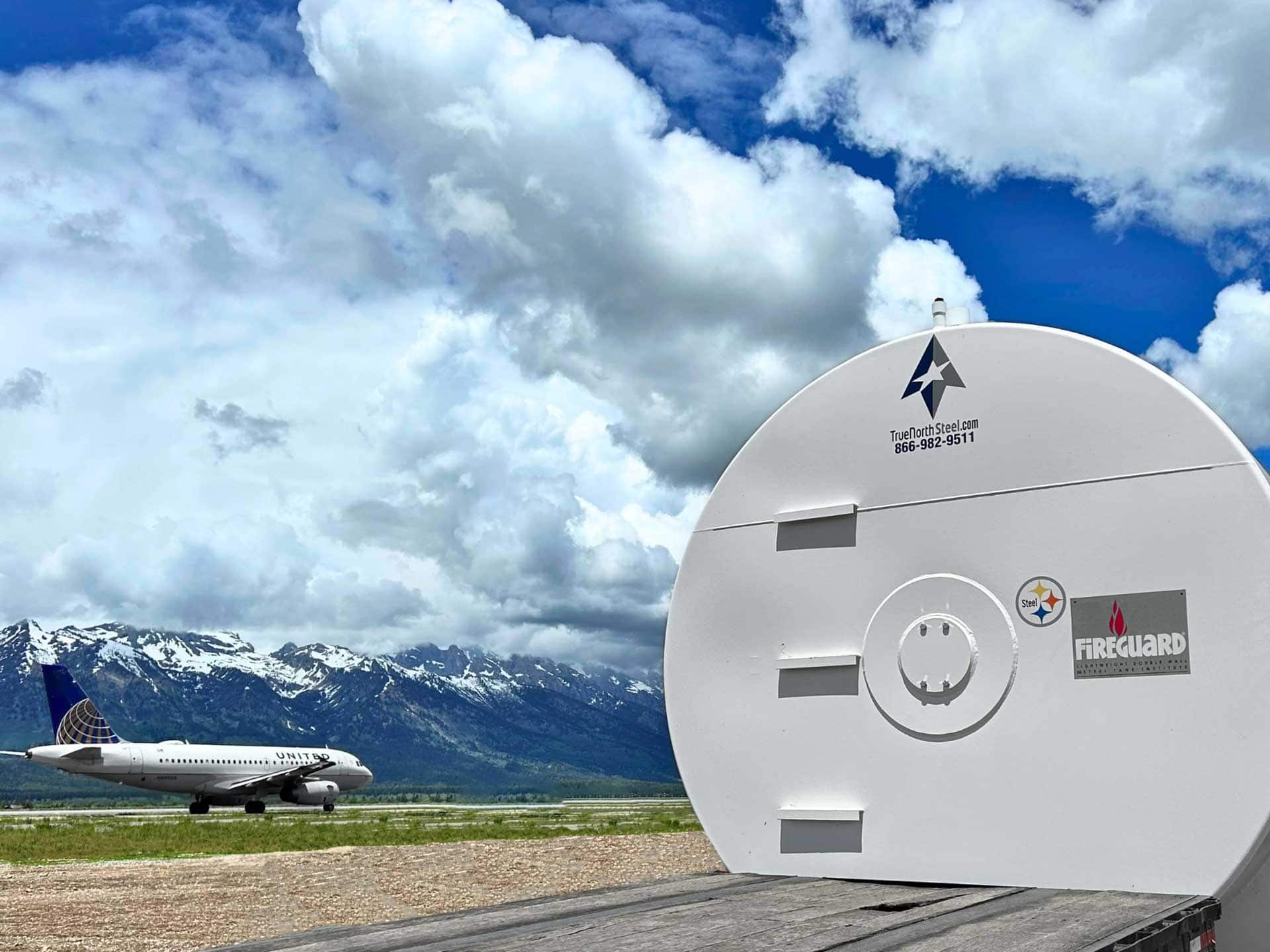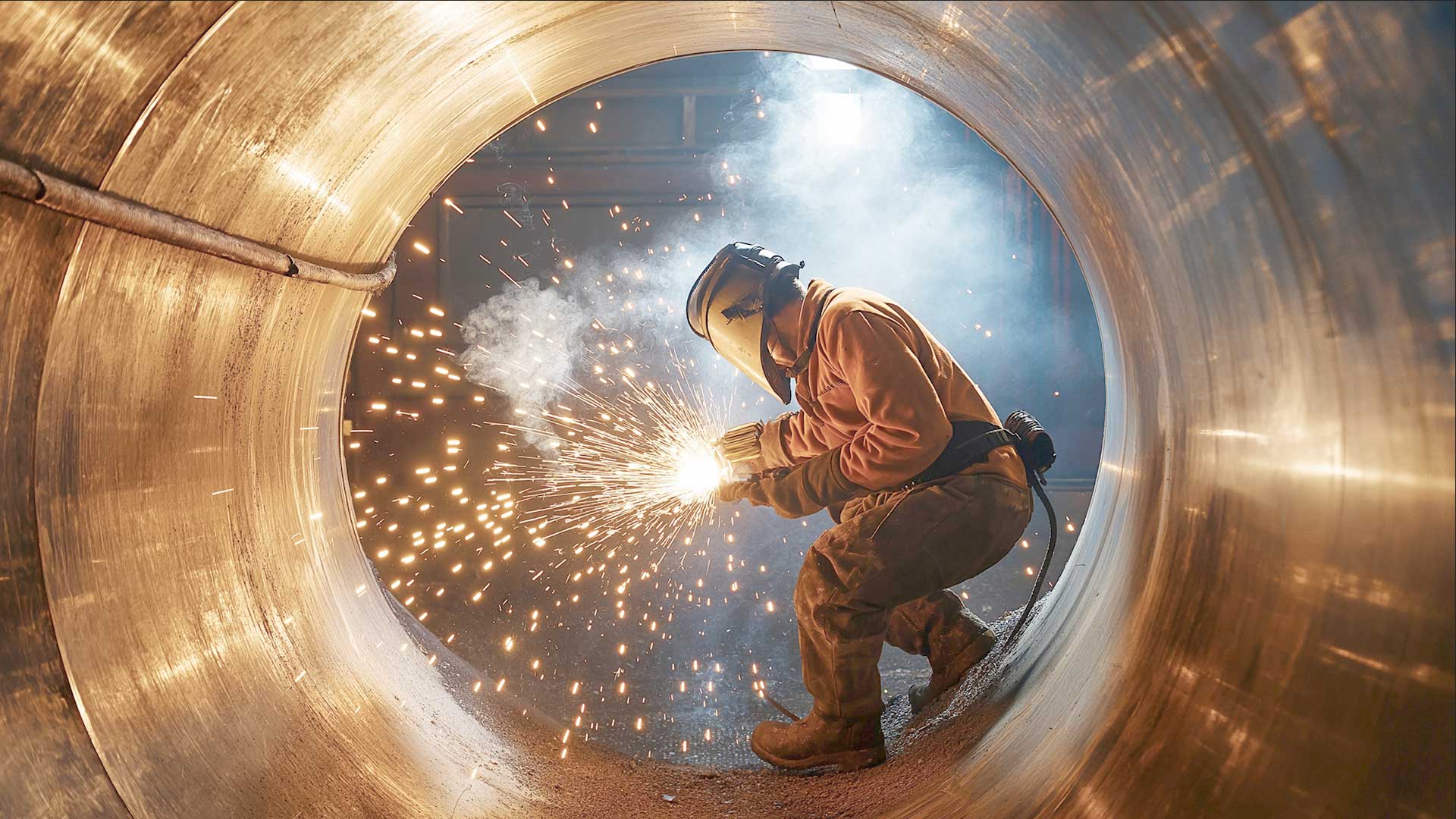
Different types of aboveground storage tanks are needed for different applications. Sometimes tank shape must change to meet needs. Cylinders, both horizontal and vertical, or rectangular tanks are available to meet storage needs, equipment support, and space constraints.
Sometimes tank location options are limited or constrained by the presence of other site buildings or property lines and when various regulations could limit how and where a tank could be placed. This can mean separation from occupied buildings, some site structures, utilities, and property lines. These location restrictions change with the characteristics of the tank contents, tank size, the application of the tank and the construction of the tank.
A fire in the area of an aboveground storage tank is a concern to owners and responders. Tanks are equipped with venting systems to help relieve internal pressure that can build as the tank contents heat up when exposed to fire. This venting system allows the tank to safely relieve increasing pressure in the tank due to fire exposure until the contents of the tank boil off or until the fire is extinguished. Note that in many cases, the discharged vapor will combust once it exits the tank.
To further help mitigate potential issues, a storage tank can incorporate design elements in its construction that help it respond in a consist manner if exposed to a fire. This can include supports that will withstand heat exposure and thermal insulation systems that limit the transfer of heat from outside of the tank to the tank interior. Model Fire Codes can require tanks that incorporate elements of fire resistance in their design and certification, and beneficial placement boundaries. The allowable placement or siting will depend on the application of the tank, what the tank is storing, what fire code applies to a specific locality, and what the Authority Having Jurisdiction will allow.
The tank design options available include fire tested tanks, fire resistant tanks and protected tanks. Each type of tank is built to a recognized standards which is listed by a recognized 3rd party agency. A summary of various listings is provided in the table below.
Let’s start with a little history on tank designs and fire concerns.
The National Fire Protection Agency (NFPA) created the definition of “fire resistant tank” in the 1993 Edition of NFPA 30A. Section 2‐4.5(a) states (in part):
The construction that provides the required fire‐resistance protection shall prevent release of liquid, failure of the primary tank, failure of the supporting structure, and impairment of venting for a period of not less than 2 hours when tested using a fire exposure that simulates a high intensity pool fire…
This section was subsequently removed from NFPA 30A.
In December 1994, Underwriters Laboratories issued UL 2085 which, at that time, covered both Protected and Fire-Resistant type tanks. The 2nd edition of UL 2085, published December 1997, removed fire resistant type tanks, leaving only fire protected tanks. UL then posted a new standard, UL 2080, in 2000 which consists of the prior UL 2085 requirements for fire resistant tanks. Although referenced, UL 2080 tanks are rarely produced, and most owners select UL 2085 listed tanks.
The Southwest Research Institute (SwRI) is an independent and nonprofit applied research and development organization that offers third party certification services. The services SwRI provides include the certification and listing of flammable and combustible storage tank which are similar to the listing services offered by Underwriters Laboratory.
SwRI 93‐01 was issued in 1993 to provide a Listing program for tanks tested according to UL 2085. SwRI 97‐04 was issued in 1997 for tanks tested according to the requirements set in the 1996 version of NFPA 30A section 2‐4.5.0.
How Certifications are Achieved
To obtain any one of these ratings the tanks are subjected to a similar test by placing a test tank into a furnace. However, different results are needed to obtain the different certifications. The heat exposure test required for all certifications requires that the tank be placed in a 2000°F oven for two hours. This test exposes the aboveground storage tank to heat flux and temperature conditions representative of total engulfment in the luminous flame regime of a large, free‐burning, liquid‐hydrocarbon fueled, pool fire. At the end of the test, the tank is immediately removed from the oven and subjected to the cooling, erosive and impact forces of the hose stream test as described in the test procedure. After a cooling period, the primary and secondary tanks (if a secondary tank was present) were air pressure tested at five psi. This test pressure was maintained for one hour. The primary and secondary containment tanks remained airtight for the entire test period.
For STI/SPFA’s FLAMESHIELD® tank, SwRl reported, “The structural integrity of the primary tank and its supports were maintained during and after all testing. Also, the emergency venting remained operational during and after all testing.” STI/SPFA also opted to equip the tank with 12‐inch high saddles. After the test, the saddles were thoroughly examined and were found to be in excellent condition. The assembly was not deformed, did not sag, did not collapse or suffer other significant damage as a result of the fire exposure.
In addition to that heat exposure test, a fire resistant tank and a protected tank must also be tested to determine if the tank interior temperature exceeds the limits set by the particular certifications. To monitor the interior temperature during the heat test, each tank had 8 temperature monitors. A fire tested tank does not have an interior temperature limit as part of its certification testing. Fire resistant tank interiors must not exceed 800° F average temperature, and no monitoring point exceed 1000° F. A protected tank’s interior must not exceed 260° F average temperature, and no monitoring point exceed 400° F.
A protected tank and a fire resistant tank can also be subjected to an impact test to simulate a vehicle impact and also a ballistic test to simulate an incidental strike from a rifle bullet. To pass the impact test and/or the ballistic test the tank’s primary compartment must pass a leak test after being subjected a simulated vehicle impact and the impact of a specific rifle round fired from a predetermined distance. Tanks built to these certified designs can be appropriately marked with impact and ballistics resistance. It should be noted that an impact rated tank should still have collision protection installed if it is required by the installation code. While the impact test will suggest the primary tank will not leak after a collision the secondary tank and any insulation present will likely be damaged and render the tank unfit for service until repairs are made.
The goal of all of the rated designs is to assure that the aboveground storage tank, if exposed to a fire, will respond in a consistent manner for at least 2 hours so that efforts can be made by first responders to address the fire or secure the site. The higher level of protection of the protected and fire-resistant tank also reduce the amount of heat absorbed by the tank contents which limits the amount of vapor produced during heat exposure.
Comparison of Standards for Aboveground Storage Tanks Construction and Performance1
| Standard | Fire Test Performed | Pass/Fail Criteria | Other Requirements2 |
|---|---|---|---|
| UL 2085 Protected Tank | 2 Hour exposure to 2000° F fire | Temperature Limit: 260° avg., 400° max at any one thermocouple. | Secondary Containment Optional: vehicle impact resistance , ballistic resistance. |
| SwRI 93-01 Protected Tank | 2 Hour exposure to 2000° F fire | Temperature Limit: 260° avg., 400° max at any one thermocouple. | Secondary Containment Optional: vehicle impact resistance , ballistic resistance. |
| UL 2080 Fire Resistant Tank | 2 Hour exposure to 2000° F fire | Temperature Limit: 800° avg., 1000° max at any one thermocouple. | Secondary Containment Optional: vehicle impact resistance , ballistic resistance. |
| SwRI 97-04 Fire Tested Tank | 2 Hour exposure to 2000° F fire | Primary tank must pass a 5 psi air pressure integrity test for one hour. No internal temperature limits. | Optional: Secondary Containment, vehicle impact resistance , ballistic resistance. |
| UL 142 Aboveground Storage Tank | No fire test required | UL 142 does not address fire exposure issues | UL 142 is a steel tank construction standard. |
1Typically, products complying with a given standard would also comply with all the standards listed above. As an example, protected tanks (UL 2085) would generally meet the requirements for both fire resistant (UL 2080) and UL 142 tanks.
2All of the standards require the tank be provided with provisions to provide emergency venting of both the primary tank and secondary containment to assure safe operation of the tank system in the event of exposure to fire. The fire code applicable to the installation will set the necessary venting requirements.