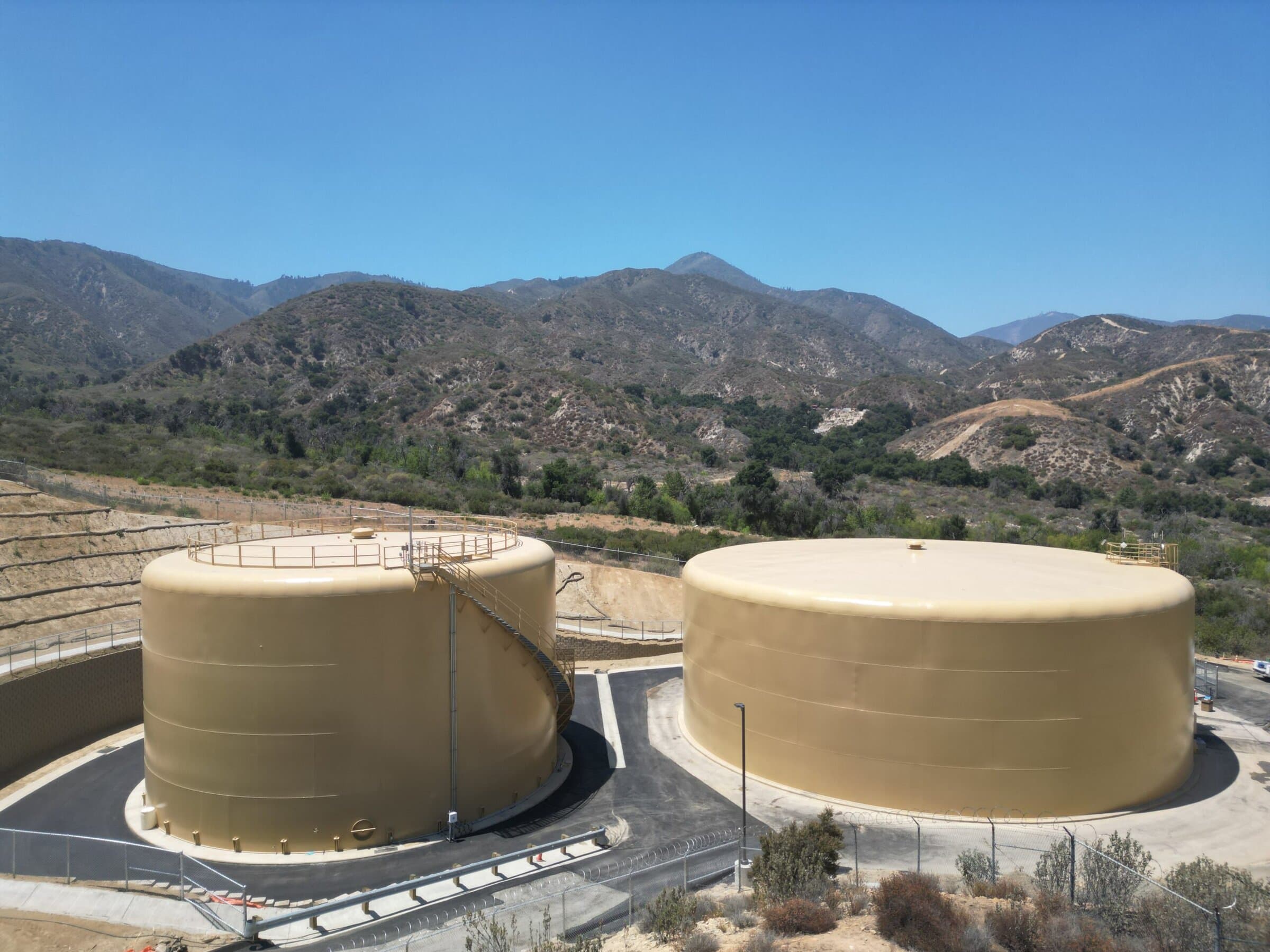
Water storage tanks play an important role in maintaining system pressure, meeting peak demand, supporting fire protection, and providing operational flexibility. They can also influence water quality.
Water may remain in a storage tank for extended periods, particularly when the tank is located far from a treatment plant, is oversized for current demand, or does not experience sufficient turnover. As water age increases, disinfectant residual may decline and conditions may develop that contribute to sediment accumulation, biofilm growth, taste and odor concerns, and the formation of disinfection byproducts.
A properly operated and maintained steel water storage tank can support water-quality management through approved interior linings, regular cleaning, inspection, mixing, and effective operational practices.
Water Age and Disinfectant Residual
Disinfectant residual naturally declines as water moves through a distribution system. Storage tanks may be located at the outer portions of the system, where water has already traveled a considerable distance from the treatment plant.
If water remains in the tank for too long, the residual may continue to decay. The rate of decay can be affected by water temperature, initial disinfectant concentration, water chemistry, organic material, sediment, biofilm, tank turnover, mixing, and distribution-system conditions.
Tank material alone does not determine water age or residual maintenance. Tank configuration, system operation, demand patterns, cycling, inlet and outlet arrangements, and mixing all play important roles.
Water-quality planning should therefore consider the tank as part of the larger distribution system rather than as an isolated asset.
Sediment and Mineral Accumulation
Sediment and mineral deposits can enter or develop within water distribution systems and settle in storage tanks.
Accumulated material may consume disinfectant, support biological activity, affect taste or appearance, interfere with inspection, hide coating deterioration, or be disturbed during changes in flow.
Regular cleaning helps remove sediment and allows the tank interior to be more thoroughly inspected. It also provides an opportunity to evaluate the condition of the lining, welds, appurtenances, and other interior components.
Cleaning frequency should be based on tank condition, water quality, operating history, sediment accumulation, regulatory requirements, and the utility’s maintenance program rather than a single universal interval.
Biofilm Development
Biofilm is a community of microorganisms that attaches to a surface and becomes embedded in a protective layer.
Biofilm can develop within distribution-system piping, appurtenances, and water storage tanks. Mature biofilm may contribute to disinfectant demand, taste and odor concerns, and other water-quality challenges.
Conditions that may encourage biofilm development include:
- Extended water age
- Low disinfectant residual
- Sediment accumulation
- Nutrient availability
- Warm water
- Inadequate mixing
- Irregular tank cycling
- Deteriorated or difficult-to-clean surfaces
Cleaning, maintaining disinfectant residual, improving turnover, and keeping the interior coating system in good condition can help control the conditions that support biofilm growth.
These practices should be coordinated with the utility’s overall treatment and distribution-system strategy.
The Role of Interior Linings
Steel water storage tanks use interior coating systems to protect the steel substrate from corrosion and provide a suitable surface for potable-water service.
The lining system should be appropriate for drinking-water contact and meet applicable requirements, including NSF/ANSI/CAN Standard 61 where required.
A properly selected and applied lining isolates the stored water from the steel substrate, provides a smooth and cleanable surface, reduces corrosion, and supports routine inspection.
The coating must remain intact to provide these benefits. Cracking, blistering, peeling, corrosion, holidays, or other deterioration should be evaluated and repaired.
A lining should not be considered permanent. It has its own service life and must be incorporated into the tank’s inspection, maintenance, and asset-management program.
Mixing and Tank Turnover
Mixing can help reduce stratification and improve the distribution of disinfectant within a storage tank.
Without adequate turnover or mixing, tanks may develop zones where water remains significantly longer than the average tank residence time. Temperature differences may also contribute to stratification.
Mixing strategies may include operational cycling, changes to inlet and outlet arrangements, passive mixing, active mechanical mixing, adjustments to operating levels, or broader distribution-system changes.
The appropriate strategy depends on tank configuration, system hydraulics, water demand, water-quality objectives, and operational constraints.
Mixing equipment should be properly designed for the tank. It should not be viewed as a substitute for appropriate tank sizing, system operation, inspection, cleaning, or maintenance.
Mixing may improve circulation without necessarily reducing the total age of the water in the system. Turnover and hydraulic operation must also be considered.
Inspection and Water-Quality Management
Tank inspections can identify conditions that may affect both structural integrity and water quality.
Interior inspections may evaluate:
- Coating condition
- Corrosion
- Sediment accumulation
- Biological growth
- Roof, shell, and bottom condition
- Welds and attachments
- Inlet and outlet arrangements
- Overflow and vent components
- Mixers and monitoring equipment
- Evidence of leakage or contamination pathways
Exterior inspections may evaluate roof openings, vents, overflows, hatches, seals, access points, security, and other features that help protect stored water from contamination.
Inspection findings should be documented and incorporated into the utility’s maintenance and water-quality planning. Conditions affecting water quality should be evaluated together with structural and coating concerns rather than treated as separate issues.
Cleaning and Return to Service
Cleaning removes accumulated sediment, mineral deposits, biological material, and debris. It also provides better access for inspection and coating evaluation.
Cleaning projects should account for tank isolation, worker safety, confined-space requirements, protection of existing coatings, material removal, inspection, necessary repairs, disinfection, water-quality testing, and controlled return to service.
The work should be planned to minimize damage to the lining and prevent contaminants from entering the tank during maintenance.
After cleaning and repair, the tank should be disinfected and returned to service in accordance with applicable procedures and utility requirements.
Tank Configuration and Water Quality
Different tank configurations may create different hydraulic conditions.
Water movement may be affected by:
- Tank shape
- Tank height and diameter
- Inlet and outlet location
- Common or separate inlet and outlet piping
- Operating range
- Fill and draw patterns
- Internal appurtenances
- Mixing equipment
Water-quality planning should consider how water enters, moves through, and leaves the tank.
A tank that is properly maintained but poorly operated may still experience excessive water age. Conversely, operational improvements may not fully address water-quality concerns if sediment, coating deterioration, or contamination pathways are present.
Tank condition, hydraulic operation, and distribution-system management must be considered together.
Operational Practices That Support Water Quality
A comprehensive tank water-quality program may include:
- Monitoring disinfectant residual
- Tracking water age and tank cycling
- Reviewing operating levels
- Maintaining adequate turnover
- Inspecting and cleaning the tank
- Evaluating sediment accumulation
- Maintaining the interior lining
- Inspecting vents, hatches, and overflow systems
- Maintaining mixers and monitoring equipment
- Reviewing seasonal demand patterns
- Investigating taste, odor, or residual complaints
- Coordinating tank operations with distribution-system flushing and treatment practices
These practices should be integrated with the utility’s broader distribution-system water-quality plan.
Accurate records of inspections, cleaning, residual measurements, operating levels, complaints, and maintenance activities can help identify patterns and support better decisions.
Common Misunderstandings
The Tank Material Alone Determines Water Quality
Tank material is one factor, but water quality also depends on system hydraulics, water age, disinfectant residual, cleaning, mixing, coating condition, and operation.
A Coating System Eliminates the Need for Cleaning
Interior linings provide a protective and cleanable surface, but sediment and deposits can still accumulate. Cleaning remains an important maintenance activity.
Mixing Solves Every Water-Age Problem
Mixing may reduce stratification and improve circulation, but it does not always reduce total water age. Tank sizing, operating range, demand, and distribution-system hydraulics must also be considered.
A Clear Tank Interior Means the Lining Is in Good Condition
Some defects may not be easily visible without a systematic inspection. Coating thickness, adhesion, holidays, corrosion, and localized deterioration may require closer evaluation.
Water-Quality Management Is Separate From Tank Maintenance
Tank condition, coating performance, cleaning, appurtenances, security, and operation are directly connected to water-quality management.
Inspection Alone Corrects Water-Quality Problems
Inspection provides information. Corrective actions may still be required, including cleaning, coating repair, operational changes, mixing, or distribution-system adjustments.
Conclusion
Steel water storage tanks can support reliable water-quality management when they are properly coated, operated, inspected, cleaned, and maintained.
Approved interior linings provide a durable and cleanable barrier, while regular cleaning helps remove sediment and conditions that may contribute to disinfectant loss or biofilm growth. Mixing, turnover, and operational planning can further improve water movement and reduce areas of extended water age.
The strongest approach is an integrated program that treats the tank as both a structural asset and an active part of the distribution system.