Respondents to the 2025 Reshoring Survey of over 500 manufacturers indicated that if trade policies were stable and provided less uncertainty, even if input costs were higher, manufacturers could support more investment in U.S. manufacturing.
More capital investment in automation and new technologies will increase output, speed, and efficiency while mitigating labor shortages, thereby increasing global competitiveness and enabling more reshoring. As manufacturers navigate geopolitical risk and trade uncertainty, the national question should not be whether to reshore but rather how to reshore. Let’s get started.
Increase Capital Investment
Three decades ago, the United States and its allies performed nearly 75% of global manufacturing. Today, that share of manufacturing has dropped to less than 50%. China’s share of global manufacturing has surged from 4.9% in 1995 to 32% in 2023. The current percentages understate China’s share because the comparison is done in value, and the Chinese price is about 40% lower than the U.S. price.
Our survey with Plante Moran and our 2025 Reshoring Survey show that manufacturing costs and prices are the overwhelming drivers of offshoring and the barrier to reshoring. U.S. manufacturing cost averages 10 to 20% higher than most other developed countries and 50% higher than those of China. Automation, including artificial intelligence (AI) and robotics help to close the cost gap compared to competitor countries, enabling more reshoring.
Make Workforce Training a Central Strategy Component
The U.S. workforce is shrinking due to structural demographic shifts, including an aging population, as baby boomers retire, declining birth rates, and changing immigration flows.
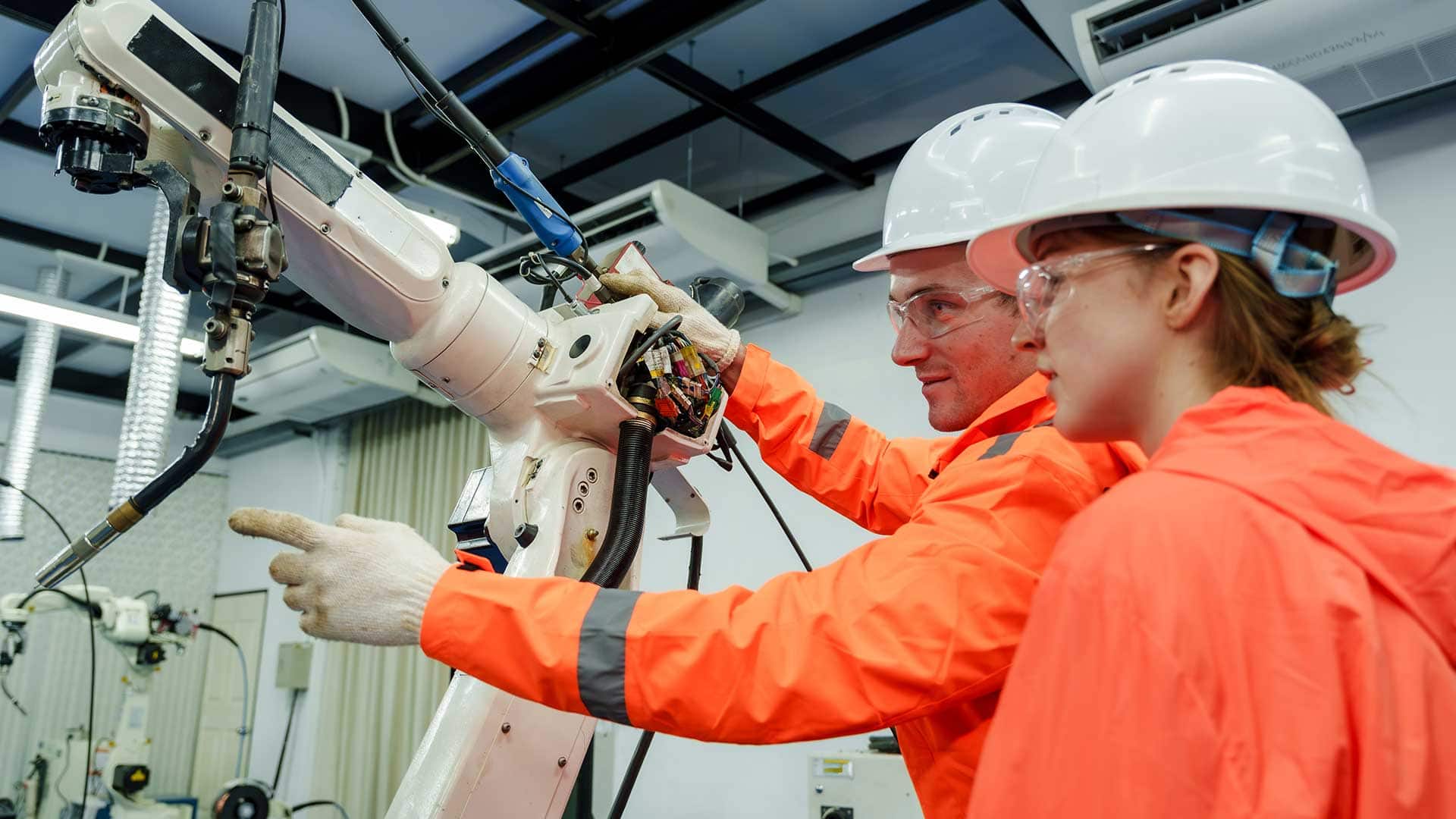
As Baby Boomers retire and tighter immigration policies reduce the U.S. labor pool, “smart” reshoring initiatives are improving efficiency. Automation, robotics, and other advanced technologies are vital solutions to labor shortages.
Apprenticeship training, i.e., combining on-the-job training with classroom instruction, is crucial to building a highly-skilled workforce that can operate and maintain new technologies and address productivity gaps.
Industry is beginning to transition to the Fifth Industrial Revolution (Industry 5.0), a human-centric approach to automation that integrates human craftsmanship and decision-making with advanced technology. Robotics and advanced manufacturing technologies are replacing lower-skilled jobs with higher-skilled, tech-driven roles.
Tech-enabled workers will need to work well in tandem with automated technologies and robots. Companies that treat workforce training as a central component of their automation strategy will be well-positioned for measurable gains.
A Successful Automation Deployment
Foliot, a Canadian-based furniture manufacturer with manufacturing facilities in Canada and the United States, invested in automation that paid for itself in 16 months. First, Foliot conducted a pilot deployment of CRX-30 cobots from FANUC at its Canadian facility. The project was so successful that Foliot installed 11 units at the Canadian plant and a system at its Las Vegas operation. Workers were trained and shifted to the new automated stations. The robots increased throughput by 15% while achieving zero accidents in the robot cells and improving employee retention.
More Than Half of the World’s Industrial Robots are Installed in China
China had over two million robots in operation as of late 2024, leading the world by a considerable margin. The latest World Robotics report published in 2025 by the International Federation of Robotics found that China was responsible for 54% of all new robot installations worldwide in 2024 with a record 295,000 units installed.
China’s massive industrial robot footprint is about five times larger than the United States in terms of installed base (robots in operation), giving it a significant advantage in manufacturing efficiency, production speed, and labor cost reduction. China’s automation dominance further reduces U.S. competitiveness by achieving lower costs and unmatched manufacturing efficiency.
Robot adoption relative to the number of robots per 1,000 manufacturing employees in South Korea is particularly striking, with more than one robot for every 10 manufacturing workers. This perspective ranks the United States tenth, close to the European Union average.
China’s relative investment in automation is driven by its massive increase in output. Companies had to invest to meet the world’s demand for their lower-priced goods and had the margins to do so. In contrast, U.S. demand has been flat to down for decades, resulting in under-investment. Aggressive reshoring has and will flatten growth in China, reducing investment. Surging U.S. manufacturing will drive investment here. Reshoring needs automation. U.S. automation needs reshoring.
Accelerate Automation Adoption — Close The Automation Gap
A recent 2026 survey concluded that U.S. manufacturers should rapidly accelerate automation to sustain global competitiveness. Ninety-two percent of respondents agreed that automation is essential for long-term sustainability, but only 37% have achieved significant or complete automation, widening the “automation gap.”
Fixing the automation gap requires a multifaceted approach, including a national robotics strategy, more STEM/apprenticeship training, incentives for automation adoption, and a stable, continuous policy that encourages investment in new factories and capital equipment.
Invest In Advanced Manufacturing For Productivity Gains
Historically, China’s labor productivity growth has exceeded U.S. rates, with recent years showing above-trend growth of approximately 4-6%. China’s labor productivity gains are driven by investments in higher-tech manufacturing, including automation, robotics, AI, and smart factories, while expanding sectors like semiconductors, EVs, and advanced manufacturing.
Ben Armstrong, a research scientist and executive director of the MIT Industrial Performance Center said, “What we’ve seen since 2010 is actually a decline in real productivity for U.S. manufacturers.” Both China and the U.S. support new manufacturing technologies like automation and AI, but China is more aggressively implementing them, while U.S. manufacturers are mostly, at best, investing to maintain the status quo.
It’s Go Time — Harness Competitiveness and Reshore
A PwC study of more than 400 worldwide manufacturing executives concluded that manufacturers expect to more than double their use of automation and advanced technologies by 2030. To be globally competitive, it’s “go time” for U.S. companies to build a competitive advantage with automation and new technologies. Ryan Hawk, global and U.S. industrials and services leader at PwC, said, “The question is no longer whether companies will adopt new technologies, but how fast they can integrate them.”
Are you thinking about reshoring?
Access the full list of Reshoring Resources offered by the Reshoring Initiative. For help, contact me at 847-867-1144 or email me at harry.moser@reshorenow.org.
Have you reshored a metal component or product? Apply for the National Metalworking Reshoring Award. The 2026 winner will be honored at IMTS 2026.
Participate in the 2026 Reshoring Survey. Your response will help influence national policy.
This article was originally published by IMTS and was republished with permission from The Reshoring Initiative.